Building an app with AI versus hiring developers
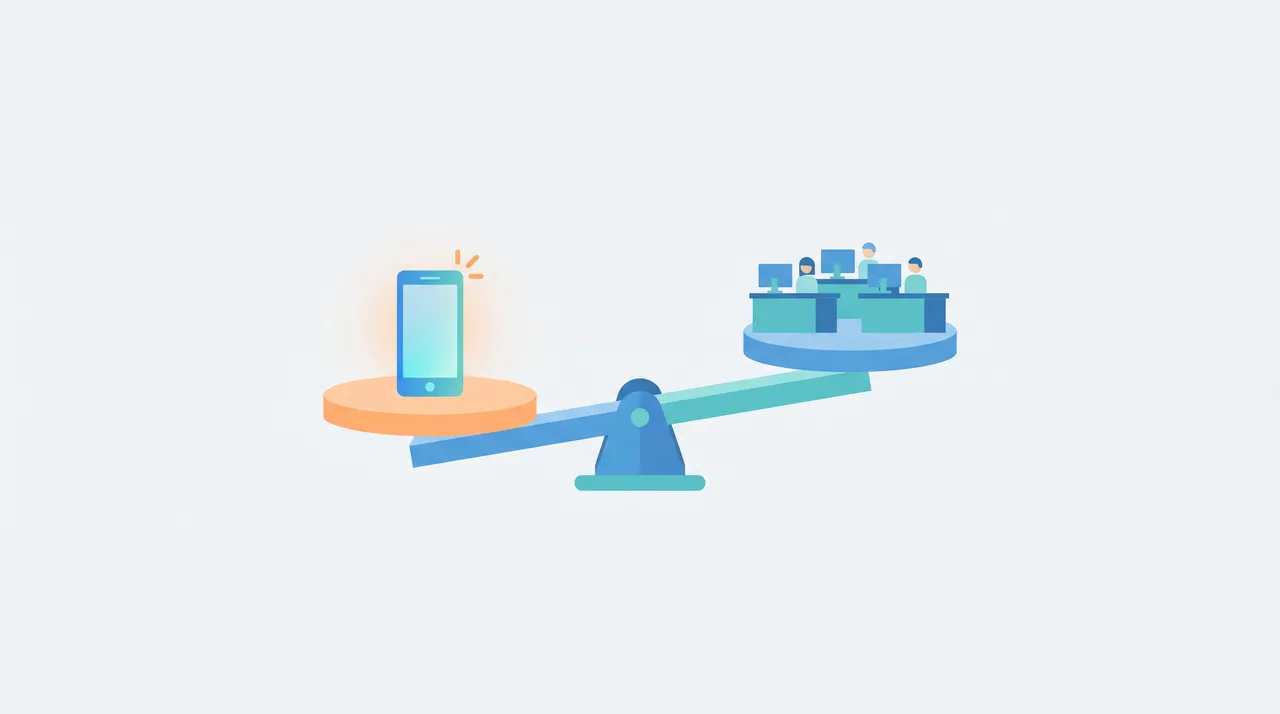
If you're an entrepreneur in the Gulf and need a ready-made app within weeks, not months, then building an app with AI is the fastest and cheapest option for most first projects. The difference is not simple. A traditional development team could cost you tens of thousands of riyals and consume months, while you reach a working version with a fraction of that through AI tools. But the story is not always that straightforward. Let's break down the numbers, time, and effort honestly, so you can decide for yourself.
The fundamental difference in building approach
Both methods reach the same goal: a working app. But the path is completely different.
With a traditional team, you start with requirements meetings, then UI design, then coding, then testing. Each phase depends on the previous one. Any delay in design delays development. With AI, you describe your idea in Arabic, and the assistant generates an initial version within minutes that you edit by voice.
Take a real example. A restaurant owner in Jeddah wanted a simple order app with a menu, cart, and payment. The traditional route means a contract with a software company and three months of waiting. Through a platform like codeyy for building apps in Arabic, he reached a working prototype in two days. Same idea, completely different speed.
What distinguishes the AI path is that you stay in the driver's seat. You don't wait for a developer to respond to every small change. Want to change a button color or rearrange screens? You write it and it happens immediately. This independence alone saves weeks of back-and-forth messaging that everyone who's dealt with an external vendor knows well.
How much does each option actually cost you?
The cost difference is the first thing any entrepreneur feels, and it's huge.
Hiring a traditional development team in the Gulf means high salaries or contracts. One skilled developer in Saudi Arabia or the UAE might ask for a monthly salary ranging between 15,000 and 30,000 riyals. And a serious app needs more than one person: a frontend developer, a backend developer, a designer, and a project manager. Add up the numbers for three months and the cost easily exceeds 150,000 riyals before you launch anything.
Using an external development company seems cheaper, but medium-complexity app contracts usually start from 50,000 riyals and go up quickly with each additional feature. And you're often surprised by annual maintenance costs that weren't budgeted for.
In contrast, AI-based tools work on a modest monthly subscription, usually for tens of dollars, not thousands. You're paying for the tool, not human hours. This means your budget for launching your first project could be less than a week's salary for one developer.
My frank advice? If your budget is under 30,000 riyals and you haven't tested your idea in the market yet, spending everything on a traditional team is a big risk. Build a first version with AI first.
Let's take a real example: say you want to build an app for booking appointments at a dental clinic. If you hire a freelancer, you might pay between 15,000 and 40,000 riyals depending on their experience and feature complexity. A local development company team might ask for 80,000 riyals or more. In contrast, AI app-building platforms could deliver a working prototype with a monthly subscription that doesn't exceed a few hundred riyals.
- Visible costs: developer salaries, platform fees, tool licenses.
- Hidden costs: recruitment, interview time, training period, and beginner mistakes.
- Cost of delays: every month of delay means a lost market opportunity that may never come back.
Practical rule: calculate the total cost over a full year, not just the initial project price.
How long does it take to build an app with AI?
Building an app with AI usually takes hours to days for a testable first version, versus two to six months for a traditional team. The difference comes from the assistant generating code directly from your description instead of writing it manually line by line.
Time is the real currency for startups. Every week of delay means a competitor could beat you, or a market opportunity narrows.
With the traditional path, weeks are lost in the pre-development phase alone: writing specifications, interviewing candidates, negotiating contracts. Then the real building clock starts. Experience with project owners tells me that a first usable version rarely appears before two months.
AI tools skip all that. You describe the idea and you get the app structure immediately. Check the guide to creating your first app to see how few steps there are. Quick testing comes right after, and you can follow its details on the test your app.
page. What nobody tells you: real speed isn't on day one, it's in the updates. Want to add a new page after a week? Traditional means a new task card and waiting for a development cycle. AI means one sentence and an instant change.
To clarify the time difference, here's an approximate timeline for building a moderately complex app:
- Traditional hiring: 4 to 8 weeks for hiring and setup, then 3 to 6 months for development.
- AI: prototype within days, ready-to-launch version within a few weeks.
This difference is critical if you're testing a new market idea or seeking funding based on a tangible product.
Administrative effort: who runs the project?
The difference in personal effort you invest is significant, and often overlooked in calculations.
Managing a human development team is almost a full-time job. Daily meetings, task tracking, resolving technical disputes, reviewing work, and ensuring everyone understands your vision. If you're not technical, you'll feel like you're translating between two languages all the time.
I heard a familiar complaint from an e-commerce store owner in Riyadh: she requested a button in a certain place and it came in a completely different location because instructions were misunderstood. Two weeks lost on a small detail.
With AI, you're the developer and manager together, but without the burden of human management. You describe in Arabic what you want, see it, and edit it yourself. No misunderstanding, no waiting for an email reply. Check how to describe your idea to master this skill, it's more important than any programming experience.
This doesn't mean zero effort. You need clarity in your head about what you want to build. But the effort shifts from managing people to articulating ideas, and that's much easier for a non-technical entrepreneur.
Quality and flexibility in the long run
Here the balance starts to tip a bit, and it's fair to say it frankly.
A skilled traditional team gives you complete control over every technical detail. Very complex applications, custom internal systems, precise banking integrations, high performance under millions of users—these still make professional developers the logical choice.
But most projects in the Gulf don't need this complexity from day one. A store, a booking platform, a service app, an internal company tool—these are all within what AI tools build with excellent operational quality.
Flexibility is a surprising strength of AI. Continuous updates and improvements become part of your daily routine instead of a separate project. Check updates and improvements to see how development turns into ongoing dialogue.
My advice: start with AI, launch, gather real users, and understand what they actually want. If you grow to the point where you need a custom technical infrastructure, by then you'll have data and revenue that justify hiring a team. Building backwards — a huge team before any customers — is what kills most startups.
Over the long term, technical debt becomes an issue. Apps built quickly with AI may accumulate code that's hard to maintain if your requirements grow significantly. That's why it's recommended to review code periodically and document the architecture from the start. In contrast, an experienced human team builds a scalable structure from day one, but at higher cost.
The optimal solution is often hybrid: start with AI to validate your idea, then bring in a human developer to restructure the critical parts once the app proves its business value.
Security and deployment: are you losing something?
Security concerns are legitimate, especially with customer data and payment systems in the Gulf market.
The common misconception is that a human team alone ensures security. The truth is security depends on the practices followed, not who wrote the code. A careless developer might leave vulnerabilities worse than a platform built with modern standards.
Serious AI tools build your apps on secure cloud infrastructure, with encryption and automatic updates. Check the page your app security to understand the layers already in place. And user login management becomes ready in a few steps, as in login in your app.
Deployment itself was traditionally a headache: servers, domains, certificates, complex configurations. A traditional team needs a DevOps engineer for this. AI shortens it to a button press, with details in deploying your app.
What we learn from experience: the biggest security gap isn't in the code, but in weak passwords and poor permission management. That's your responsibility either way, whether you hire a team or build yourself.
When is traditional hiring the right choice?
Traditional hiring is better when your product's core is complex, unique technology, or when you're handling sensitive data requiring special regulatory certifications, or when you've reached a massive user base requiring performance engineering that's hard to automate.
I'm not against traditional hiring. I'm against using it in the wrong place.
If you're building a regulated financial platform approved by the central bank, or a medical app handling patient records, or a system needing complex custom algorithms, a specialized human team is a justified investment. These aren't 'quick first version' projects.
Similarly, companies that have achieved significant growth and need a permanent in-house team for ongoing maintenance and development, hiring becomes economically logical then.
But watch out for a common trap: many hire an expensive team based on an untested idea. Then six months and a hundred thousand riyals later, they discover the market doesn't want the product at all. If they'd built a quick AI version first, they'd have known in a week for the cost of dinner.
The simple rule: test with AI, scale with humans. Not the other way around.
The practical decision for the Gulf entrepreneur
The practical takeaway: start today with AI, especially for your first project or any idea that hasn't proven itself yet.
The math is clear. Cost savings of over 90% compared to a traditional team in the initial phase. Time savings from months to days. And independence that frees you from waiting on others.
Picture the scenario: you have an idea for a salon booking app in Dammam. The old way means a contract for fifty thousand and three months. The new way means testing the idea this week, getting your first ten customers, then deciding based on real numbers.
You can browse codeyy's blog for more stories and details, or simply start free and build your first version tonight. The idea you've had in your head for months deserves to be seen working, not locked away in a presentation.
Practical scenarios: which approach fits your project?
The decision isn't absolute, but depends on your project's nature and stage. Here are three common scenarios among Gulf entrepreneurs to help you find your direction.
Scenario one: a new idea you want to validate
If you're in the idea-testing phase, building an app with AI is the smartest choice. You deliver a prototype quickly, show it to potential customers, and gather real feedback before spending large sums. Many startups discovered their original idea needed major revision, and AI makes that revision cheap and fast.
Scenario two: a successful product that needs to scale
When your app proves its worth and user numbers grow, you need a more robust structure and complex features. Here traditional hiring — whether an in-house team or a specialized firm — becomes a justified investment. You're now building on solid ground, and you know exactly what your customers need.
Scenario three: a specific project with a reasonable budget
For some simple functional apps, like an internal inventory management app or a booking tool, AI alone might be enough without needing a human team at all. The key is defining the project scope precisely from the start.
Practical steps to start today
Whatever approach you lean toward, here are concrete steps that move you from thinking to doing:
- Write your requirements clearly: define the problem your app solves and the three or four core functions the app can't work without.
- Set a realistic budget ceiling: put a number you won't exceed in the initial phase, and allocate part of it for emergencies.
- Try one AI platform: build a simple prototype in two days to assess how well it fits your idea.
- Measure results before scaling: show the prototype to ten real users and gather their feedback.
- Plan for a hybrid transition: decide in advance when you'll need a human developer and what parts they'll handle.
This way, you're not locked into one choice, but building a flexible path that evolves with your project's growth. AI gives you speed at the start, the human element gives you depth at maturity, and combining them is what sets the smartest Gulf entrepreneurs apart in the market today.
Frequently asked questions
Can I build an app with AI without any coding experience?
Yes, absolutely. Tools like codeyy are designed for non-technical people. You describe your idea in Arabic in plain language, and the assistant handles code and structure generation. The skill you need most isn't coding, but clarity about what you want to build and how your app should behave. Learning comes with use.
How much does building an app with AI cost compared to a Gulf development company?
A Gulf development company might charge 50,000 riyals or more for an average app, plus additional annual maintenance costs. AI tools work on monthly subscriptions often in the tens of dollars. The difference is huge in the early phase, making it possible to test your idea on a very limited budget before any major commitment.
Is an app built with AI secure for my customer data?
Yes, if you use a serious platform that builds on encrypted cloud infrastructure with automatic updates. Security depends on the practices followed, not who wrote the code. Check the security documentation to understand the layers in place, and make sure you maintain strong passwords and proper permission management — that's your responsibility regardless.
When do I move from AI to a human development team?
Move when your project proves successful and needs special technical complexity that's hard to automate, or a massive user base requiring precise performance engineering, or strict regulatory integrations. The rule: test and scale with AI first, then hire humans when you have data and revenue that justify the large cost.
What if you need complex features that AI doesn't support?
That's where the hybrid approach comes in; you can export the code or connect the app to external services via APIs, then hire a developer to add specialized functions that are hard to fully automate with AI.
Is my data safe on these platforms?
Review the privacy policy and server location before subscribing. Choose platforms that comply with data protection standards recognized in the Gulf market, especially if you're handling sensitive customer information or payment data.
Which is better for a startup with a tight budget?
Usually AI, because it lets you test the market with minimal financial risk before committing to a full development team and fixed monthly budget.